
CTB Community Spotlight: Christopher Johnson , President of TWU Dallas
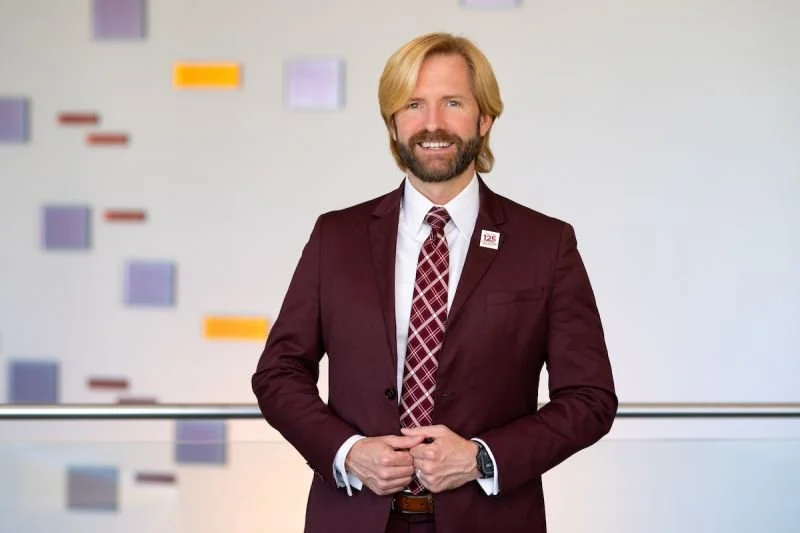
Christopher Johnson, President of Texas Woman’s University - Dallas
In August, the Texas Woman’s University Board of Regents unanimously voted to move forward with the launch of a Come to Believe model college as part of its Dallas campus. That vote was the result of a year-long effort at TWU led by Christopher Johnson, the recently appointed President of TWU’s Dallas campus. Christopher has been at TWU for more than sixteen years and most recently served as Vice Chancellor for Strategy and Chief of Staff to TWU’s Chancellor. CTB’s Carlos Martinez sat down with Christopher to discuss his background and road to higher education leadership, his participation in CTB’s design grant program, and his vision for TWU Dallas. You can listen to the full coversation on CTB’s podcast channel.
Note: Answers have been lightly edited for length and clarity.
Please introduce yourself and tell us about your background including your path to higher education.
My name is Christopher Johnson and I am the president of Texas Woman's University in Dallas. TWU has three campuses, one in Denton, one in Dallas, and one in Houston. I was just named president here in Dallas about a month ago, but I have been at Texas Woman's University in other capacities for more than 16 years now.
Let me start back with where I grew up, because I think that will highlight my pathway into higher education. I grew up commercial fishing in rural Alaska. I was the oldest of six children, and neither of my parents had a college degree, so I definitely fit the definition of a first-generation college graduate. But I will say that my household and my parents were very big into reading and education. And I don't think it was necessarily because of what they hoped it would do for me economically, but because they believed it would make me a fuller human being and a stronger contributor to the common good.
And then my grandmother grew up in Chicago. She was born in 1919, in an era where a lot of women didn't have a lot of opportunities, but she brought to rural Alaska all that intellectual and artistic culture from the city. One example is she wanted me to learn to play the piano. So she bought a piano in rural Alaska, and I learned to play the piano because of that.
So juxtaposing that commercial fishing, rural, hard-work livelihood with the intellectual, cultural, classical music component, I think we all learned to love learning. I became good at mathematics and it eventually became my discipline.
I'll also add that none of my brothers and sisters currently have a bachelor's degree. I think they're all extraordinary and capable people, but they just didn't have those opportunities that I lucked into, and I have watched them struggle sometimes with the barriers that not having a credential puts in the way of them getting opportunities.
One thing higher education gave me was opportunities I couldn't have imagined growing up in rural Alaska. But it has also allowed me to continue doing something that my family taught me, which was to value lifelong learning, and learning as a way of becoming a fuller human being.
In your previous role as chief of staff to TWU's chancellor and vice chancellor for strategy, you had a unique vantage point on TWU's mission and how it's implemented in practice. In your view, what's most special about TWU?
Where to begin? I think back to the founding in 1901, when it was very much about providing an educational opportunity for a population that was systematically excluded from higher education, namely women. What I love about that story is that it's about our founding, but you can still see it in who we serve today and how we operate.
TWU has this remarkable ability to look at a student not for their pedigree but for the potential that they have. At an institution where women routinely see other women in leadership, in labs, in health professions, business, research, etc., it's been really eye-opening to see the impact that has on the young women who start here, young women and men I should say, since we are coeducational.
For the last 16 years that I've been here, I've really recognized that mission probably matters more in practice than anything else. We have a tagline now that TWU is breaking barriers, but I don't think it's just a tagline. I think it's really woven into our essential purpose. And that's what we've been doing for 125 years.
CTB and TWU began working together last fall. Do you remember your first thoughts when you heard about CTB for the very first time?
In some ways it sounded simple, but when you start looking at what it's doing, it's also pretty radical. CTB began with the premise not that something's wrong with students, but that something might be wrong with the pathways we've built for them. When you put a small college inside a four-year university, you keep those expectations high, and then you surround students with that extraordinary support, it just makes the outcomes work, right? And those outcomes were one of the things that really started to spark my interest, because having an idea is one thing, but having outcomes is something else entirely, especially when you're trying to convince other people to implement a model.
I really saw it as that startup incubator concept. In Silicon Valley, people talk about moving quickly because they're trying to change things, and huge organizations are really hard to change. That's very much true for higher education. Institutional policies and systems are very difficult to redesign at scale. What this college does is allow us to build things differently from the beginning: try new approaches in a concentrated environment and rewrite university policies in a specific way. And what I'm most excited about is what those could do in terms of scaling across the institution later. What we are able to implement and show works in this college will then allow us to expand those benefits to our broader population.
My hope is that this college does not just transform the lives of 300 students a year, but that it's going to teach TWU how we can better serve all 16,400 students we have here through the best practices we learn from the CTB model.
As part of this partnership, you and some of your TWU colleagues visited Dougherty Family College in Minnesota in October 2025. What stood out to you from that visit?
So many things. I think that was really when my eyes opened. It's one thing reading about something and thinking theoretically about outcomes, but seeing them, talking to the students, alumni, faculty, and administrators, it was absolutely a collection of support that was really inspiring.
The other thing that stood out to me was how the team at DFC set the expectations for students high. They emphasized over and over again: this is not about remedial education, and it is not about lowering the bar. It was a model that said, let's set high expectations with high support. And I don't think that's something that happens often enough in higher ed. We oftentimes think that doing high support means we should lower expectations at the same time. But that is absolutely not what DFC did, and that was super inspiring.
One of the students said something that resonated with me, and still today I remember it just like it was yesterday. She said DFC gave her hope she didn't know she needed. That is absolutely an inspiring part of what this could be. You don't see that kind of quote in the metrics or in the numbers, but you see it in the stories that they tell.
So I left thinking, how could we make this work at TWU? We are not a private institution. We're a public institution. But in a similar way we have a distinctive mission, as St. Thomas does, as Loyola does, and so there are a lot of parallel things I think we could learn. What I took away from that first visit was: This is amazing. How can we adapt it for the Texas environment? How can we adapt it for our mission? How can we adapt it for a public environment? It was such an inspiring visit.
You're now the president of TWU's Dallas campus. Can you tell us about your vision for TWU Dallas and how CTB fits into it?
My vision is pretty simple: create an urban university campus. And that's not just a university built in a city location. Dallas itself should become part of the educational experience, whether it's the hospitals and health care systems, the businesses, the nonprofit organizations, the cultural organizations, the neighborhoods, or the civic institutions we have here. I don't envision a traditional campus surrounded by a fence, or even contiguous at all, but one really connected into this urban footprint. Our presence is here in the Southwestern Medical District, we have emerging opportunities elsewhere in the city, and now we're going to have space in downtown Dallas.
CTB is really important because it gives us permission to participate in that vision downtown, which is something I wanted to do anyway, and this gives us a way to do it in a really strong and powerful way. That's super exciting to me. I just think we should build a stronger university presence in Dallas, not just for the sake of TWU, but for the sake of Dallas and the students it has to serve.
There are just so many opportunities. I'll give an example. So often residential campuses think student life is about creating programming on campus for students to engage in. But in Dallas, we have the Dallas Opera, the Dallas Museum of Art, incredible things. We have the largest downtown arts district in the nation. We should be engaging those students in all of those cultural opportunities. We have the Latino Cultural Center just on the east side. We have so many rich, unique opportunities to engage in the life of a city and in humanity more broadly, because cities like Dallas, Chicago, and Minneapolis attract some of the best talent in the country and the world. Using that epicenter to connect our students with those talented folks, to encourage and inspire them, is exactly what I think an urban university campus is all about. It's about leveraging what the city has for the benefit of students who might not even know about the great talent that comes to Dallas all the time.